You've gone sale agreed, and everyone from your solicitor to your parents says the same thing: get a survey. But few buyers can say what a surveyor actually does for the money — what gets inspected, what gets a disclaimer, and what never gets looked at in the first place. Here is what a pre-purchase survey in Ireland covers, the three levels you can commission, and the checks that are not part of any surveyor's job — so nothing falls into the gap between the professionals.
The three types of pre-purchase survey
The Society of Chartered Surveyors Ireland (SCSI) defines three levels of pre-purchase survey, and asking for the right one matters more than most buyers realise:
| Type | What it is | Suits |
|---|---|---|
| Type 1 | A concise condition report: the surveyor rates the visible condition of the main elements without detailed commentary. | Newer, conventionally built homes in apparent good order |
| Type 2 | The standard choice: a fuller inspection and written report on each element, flagging defects and recommending follow-ups. | Most second-hand houses and apartments |
| Type 3 | The most detailed level: an in-depth report on construction, defects and remedial options, sometimes with input from other specialists. | Older, extended, altered or visibly problematic buildings |
Framework: Society of Chartered Surveyors Ireland, scsi.ie
Cost scales with depth. Published provider prices put a typical pre-purchase survey at €450–€799 depending on the property's size, age and location — the report-options guide compares what each tier of due diligence costs and covers.
What the surveyor checks on the day
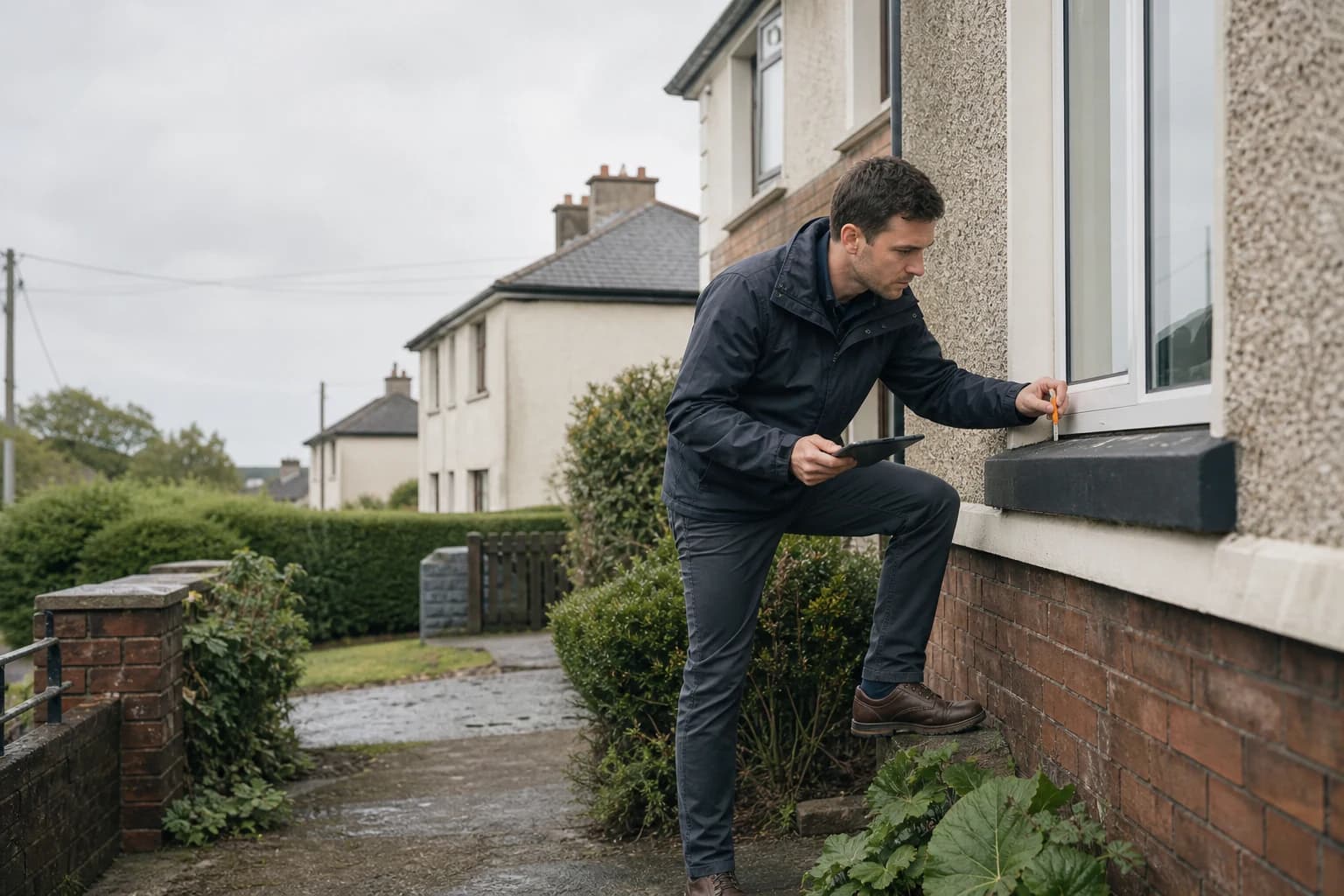
A pre-purchase survey is a visual, non-invasive inspection: the surveyor examines everything that can be seen and reached without opening up the building. In practice that means:
- Roof and chimneys — coverings, flashings, ridge lines and rainwater goods, inspected from ground level and accessible vantage points.
- Walls and structure — cracking, bowing, settlement signs, the condition of render and pointing, and evidence of structural movement.
- Damp — moisture-meter readings at walls and floors, signs of rising damp, penetrating damp and condensation, and the state of any visible damp-proof course.
- Attic and floors — where there is safe access: timbers, insulation, ventilation, and signs of woodworm or rot.
- Windows, doors and finishes — condition, operation and weather-tightness.
- Services, visually — the visible parts of plumbing, heating and electrics. A surveyor notes their apparent age and condition but does not test or certify them; that is a job for an electrician or heating engineer if the report recommends one.
- Site and boundaries — drainage where accessible, boundary walls and fences, and anything on the site that looks inconsistent with what's being sold — flagged for your solicitor to check against the title.
The limits are structural, not laziness
A surveyor cannot lift fitted carpets, open up walls, dig up drains or move the seller's furniture. If the report says an area was “not accessible for inspection”, that is the inspection working as designed — and worth reading carefully, because hidden areas are where surprises live.
What no surveyor checks
Three whole categories of risk sit outside every survey type, however thorough the surveyor:
- The legal side. Title, rights of way, easements and contract conditions are your solicitor's territory — the solicitor guide covers what conveyancing checks. The surveyor may flag a boundary oddity, but resolving it is legal work.
- The price. A survey is not a valuation. Your lender's valuation, in turn, is a brief market-value check for the bank — not an inspection for you.
- The location's records. Flood history and OPW flood zones, EPA radon classification, mica and pyrite scheme designations, planning applications next door, recorded sold prices, BER records, crime statistics: none of this is visible from the property, so none of it is in a surveyor's report.
That third gap is the one buyers most often discover after closing. The house can be structurally perfect and still sit in a flood zone, a High Radon Area, or two fields from a granted planning application — the buying-a-house checklist walks through when each check belongs in the process.
Run the desk checks first, then brief the surveyor
The order matters. A data check costs a fraction of a survey and takes minutes rather than days, so run it before you spend survey money — and then hand the results to the surveyor:
- Address in an OPW flood zone or with recorded flood events nearby? Ask the surveyor to pay particular attention to damp-proofing, drainage and floor levels.
- County designated under the defective concrete blocks scheme? Ask about render cracking patterns, and see the mica and pyrite guide for what a data check can and cannot tell you.
- Poor BER for the house type and age? Ask what the insulation and heating actually look like up close.
The 18 checks a surveyor doesn't make
A PropertyPack report compiles 18 location checks from official Irish data — flood, radon, mica designations, planning, sold prices, BER and more — for any Eircode, with a free snapshot in about a minute and the full report for €29. Most buyers run it on their shortlist, then pay a surveyor once, on the house they're actually buying. The survey guide covers how the two fit together.
About this article
Written by the PropertyPack.ie team and published 7 September 2026. Figures render directly from the official datasets behind our reports, so they update when the underlying record does. General information for Irish home buyers, not legal, financial or tax advice.