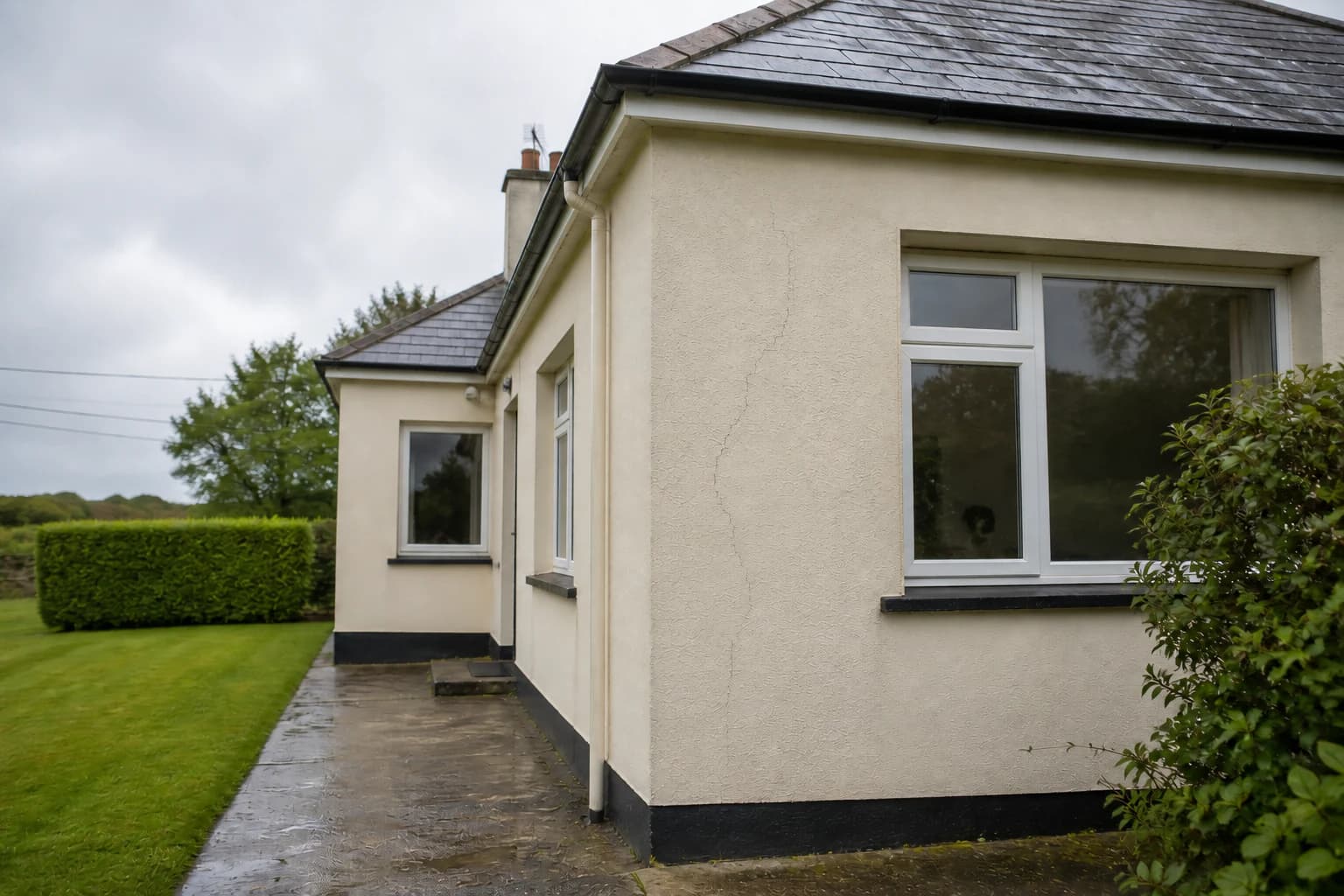
You cannot confirm mica from the street, but a viewing can tell you whether to ask harder questions. Here is what to look for, what the signs can and cannot prove, and what to do before you bid.
What are the signs of mica in a house?
Look at the external walls first. Mica-affected blocks tend to show as cracking in the render, often a map-like pattern or cracks that widen over time, and in serious cases as crumbling or bulging wall sections. Inside, check the corners of rooms and the walls behind furniture for new or growing cracks.
- Cracks that are growing. Ask the seller whether the cracks have been there long, and whether they have been repaired or painted over.
- Fresh render or paint on one wall. It may be routine maintenance, so ask what was done and why.
- Damp patches on cracked walls. Water getting in through cracks is part of how the damage progresses.
Is a cracked wall proof of mica?
No. Settlement and other ordinary causes also crack walls, and a house with defective blocks can look fine for years. Treat cracking as a prompt to investigate, not as a verdict either way. The mica risk check shows whether an address sits in an area covered by the State schemes, which tells you how seriously to take the signs.
How do I confirm it before I bid?
Confirming defective blocks in a particular building needs testing and assessment to I.S. 465, the national standard, by a competent professional. Ask the seller whether an assessment exists, whether a grant application has been made, and whether any remediation has been done. Put the same questions to your solicitor, and ask your surveyor what they can and cannot say about the blocks.
What about pyrite?
Pyrite is a separate problem, in the hardcore under the floor, and it has its own scheme. The Pyrite Remediation Scheme closes to applications on 30 November 2026, according to the Pyrite Resolution Board. Our pyrite deadline guide covers what that means for owners and buyers.
About this article
Written by the PropertyPack.ie team and published 9 November 2026. Figures render directly from the official datasets behind our reports, so they update when the underlying record does. General information for Irish home buyers, not legal, financial or tax advice.